
Written by:
 Jayson Hardie – Chief Executive Officer- (636) 256-5712
Two people can buy similarly priced homes in the same market, maybe even on the same street, at the same time, and end up with very different mortgages.
Why? Because your mortgage is built around you. Your down payment, credit profile, income, existing debts, loan program, and other details all play a role in determining what financing options are available and what your monthly payment may look like.
That’s why comparing your mortgage to someone else’s doesn’t always tell you very much. Even when the homes look similar, the borrowers and the loans may be completely different.
Your Down Payment Changes More Than Your Loan Balance
It’s easy to think of a down payment as simply the amount of cash you bring to the purchase. Put more down, borrow less. But your down payment can affect several other parts of the mortgage as well.
A larger down payment means a smaller loan balance, which can reduce your monthly principal and interest payment. Depending on the loan program and amount you put down, it may also reduce or eliminate certain mortgage insurance costs.
But putting down as much money as possible isn’t automatically the right decision. A buyer may decide that keeping extra cash available for emergency savings, home improvements, moving expenses, or other financial goals matters more than achieving the lowest possible mortgage payment.
The right down payment is about finding the right balance between what you put toward your home and what you keep available for other financial needs and priorities.
Your Credit Profile Matters
Your credit score is another important piece of your mortgage fingerprint.
Generally, a stronger credit profile can help a borrower qualify for more favorable financing terms. Credit can affect your interest rate, mortgage insurance costs, and sometimes which loan options make the most sense.
But your score isn’t the only thing lenders look at. Your overall credit history matters, including payment history, outstanding balances, recent credit activity, and other factors.
This is also why two buyers purchasing the same-priced home with the same down payment could still end up with different monthly payments. Their credit profiles may result in different financing terms. If you’re thinking of buying and need to see where you stand, you should check in with a loan advisor. They can help guide you to make the right credit moves to ensure you’re in the strongest position to purchase.
Your Debt-to-Income Ratio Tells Another Part of the Story
Your income matters, but lenders also need to know how much of it is already spoken for elsewhere.
That’s where your debt-to-income ratio, or DTI, comes in. DTI compares certain monthly debt obligations with your qualifying gross monthly income.
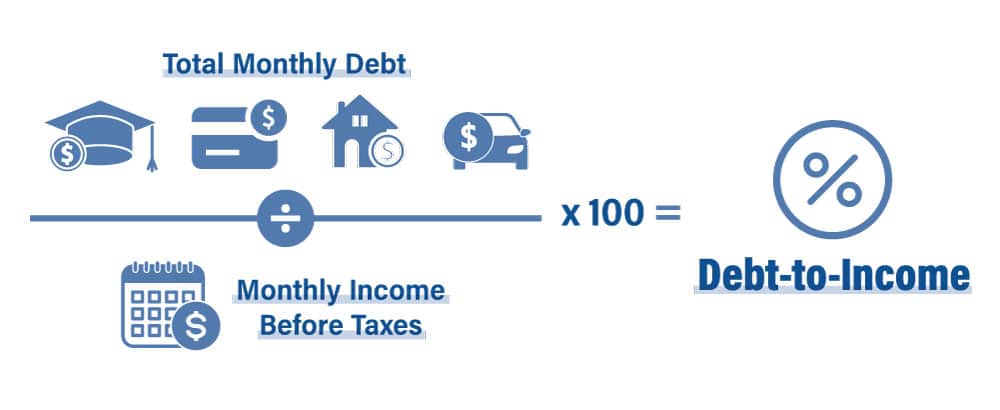
For example, two borrowers might earn the same salary, but one has a car payment, student loans, and credit card debt while the other has very little monthly debt. On paper, their incomes are identical. From a mortgage qualification standpoint, their financial pictures can be very different.
DTI can affect how much you may qualify to borrow, and which financing options are available to you. It also reinforces an important point: how much you earn is only part of the mortgage equation.
Your Loan Program Changes the Equation
There isn’t one type of mortgage that’s best for every borrower.
Conventional financing may be a good fit for one buyer, while FHA could make more sense for another. Eligible Veterans and service members may benefit from VA financing, and some buyers may qualify for other specialized programs.
Each program has its own guidelines, costs, benefits, and tradeoffs. Down payment requirements can differ. Mortgage insurance or funding fees can differ. Credit and qualification guidelines can differ from program to program, too.
That’s why choosing a mortgage shouldn’t simply be about finding the program with the lowest advertised rate. It’s about finding the structure that makes sense for your circumstances.
And Then There’s the Property Itself
The borrower isn’t the only part of the fingerprint. The property and how you plan to use it can matter, too.
A primary residence may be financed differently than a second home or investment property. A single-family home may present a different financing scenario than a condominium or multi-unit property. Loan amount and other property characteristics can also influence the available options.
So even if you used the exact same financial profile to purchase two different properties, you wouldn’t necessarily end up with the exact same mortgage. When we say each loan is truly unique, we really mean it.
All These Pieces Work Together
This is where the fingerprint analogy becomes especially useful.
Your down payment doesn’t exist independently of your credit. Your credit doesn’t exist independently of your loan program. Your DTI can influence how much you qualify for, while the amount you borrow affects your payment.
Down Payment + Credit Profile + DTI + Loan Program + Property = Your Mortgage
Change one piece, and the mortgage may change with it.
For example, putting more money down could reduce the loan balance and monthly payment. Paying down another debt could improve DTI. Improving credit could open the door to different pricing. Choosing a different loan program could change the down payment, mortgage insurance, or cash needed at closing.
That’s why mortgage planning can be just as important as mortgage shopping, and why it’s important to work with a team of trusted experts. Our loan advisors have years in the business and will help guide you to the program and loan that is best for YOU.
Don’t Compare Your Mortgage to Someone Else’s
It’s natural to talk with friends, family members, or coworkers about what rate they received or how much they put down. That information can be interesting, but it doesn’t necessarily tell you what you should expect, and it can be a deterrent.
Your neighbor may have put 20% down while you’re putting 5% down. A friend may have a different credit profile. A family member may qualify for a VA loan. Someone else may have chosen to pay points upfront in exchange for a lower interest rate.
You’re comparing two different fingerprints.
The same goes for advertised mortgage rates. They’re typically based on a particular set of assumptions. If your financial profile or transaction differs from those assumptions, your financing will differ as well.
The Better Question to Ask
Instead of beginning with “What’s the best mortgage or mortgage rate I can get?” I think a better place to start is:
“What’s the best mortgage for me?”
That means looking at more than a rate. How much cash do you want to put down? What monthly payment fits comfortably into your budget? How much money do you want to keep in savings? How long do you expect to own the home? What other financial goals are important to you?
Once you understand those priorities, you can start evaluating mortgage options in the context of your actual financial life.
Because your mortgage doesn’t need to look like your neighbor’s, your friend’s, or the one you saw advertised online.
It needs to fit you.
And just like your fingerprint, that financial picture is uniquely your own.