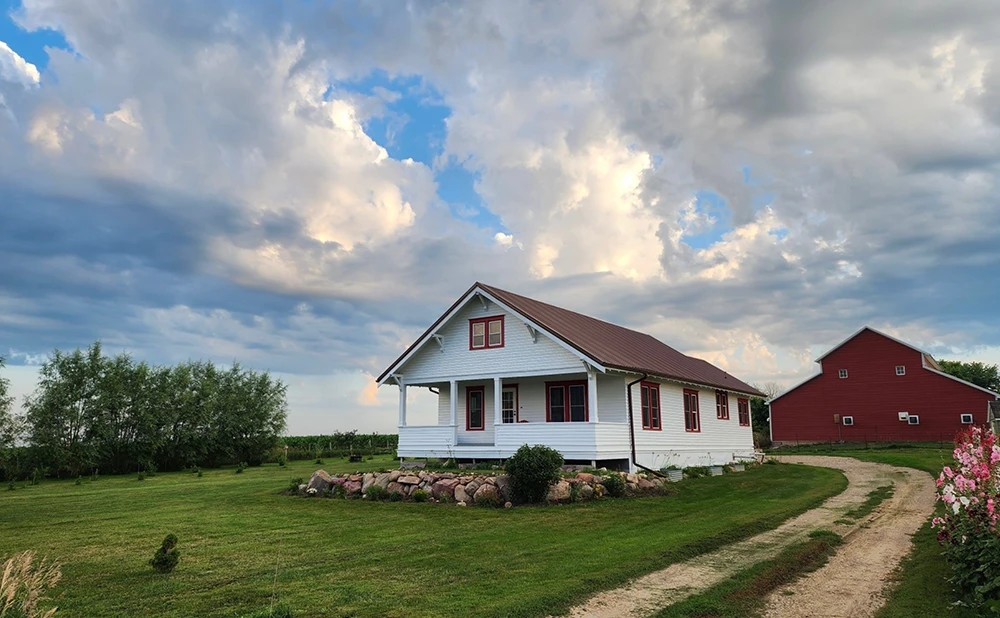
Country Living Doesn’t Always Mean Farming
Whether it’s more space, fewer neighbors, room for horses, or a few acres of land, there are plenty of reasons buyers look beyond traditional neighborhoods when searching for a home. But financing a rural property can look a little different, especially when acreage or agricultural use is involved.
USDA loans are often the first option that comes to mind, but they’re not the only choice. Rural Home Loans and Hobby Farm Loans provide additional ways to finance country properties, depending largely on the property, how much land is involved, and how you plan to use it.
What Is a Rural Home Loan?
A Rural Home Loan is designed for borrowers whose primary income comes from off-farm employment and who are purchasing or refinancing a primary residence in an eligible rural community.
Unlike agricultural lending, these loans focus on the home rather than farmland or commercial farming operations. Eligible properties are generally single-family homes in good condition, typically on fewer than five acres and located in rural areas or communities with populations under 2,500.
The property must remain residential and should not be capable of generating agricultural income.
What Is a Hobby Farm Loan?
What if your country property has ample land, or you want to use part of it for agriculture? That’s where a Hobby Farm Loan may come in.
Hobby Farm Loans are designed for rural residential properties with agricultural land or small-scale agricultural activity without being operated as a full-time commercial farming business.
These properties may include acreage, horses, livestock, outbuildings, crops, or other agricultural features while the borrower’s primary occupation remains outside of farming.
Rural Home or Hobby Farm: What’s the Difference?
The distinction isn’t simply whether the property is “in the country.” How the land is used matters.
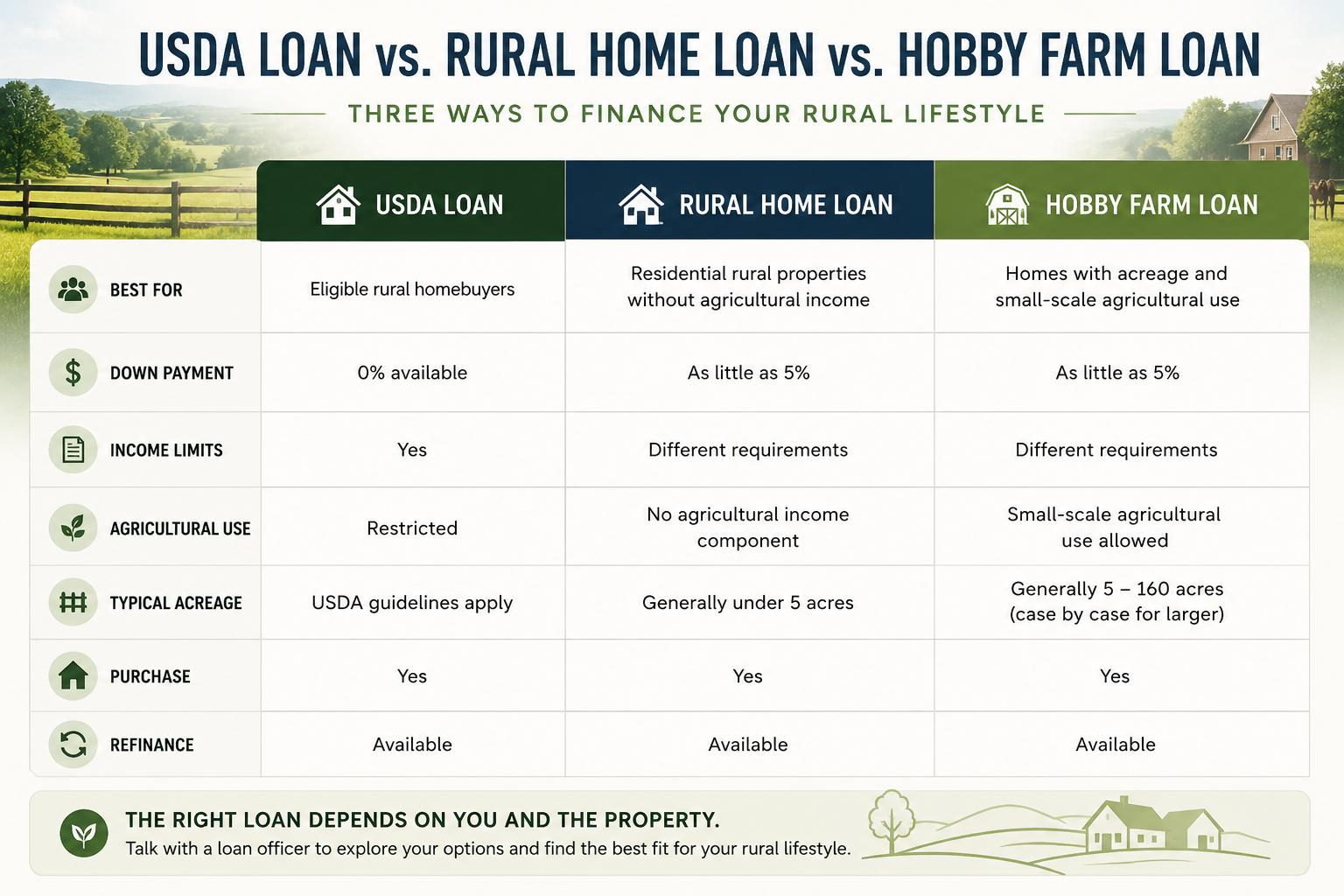
A Rural Home Loan is generally intended for properties that are primarily residential, with no agricultural income component, and typically have fewer than five acres.
Hobby Farm Loans can accommodate agricultural activity and larger properties, generally ranging from 5 to 160 acres, with larger properties considered on a case-by-case basis.
For properties with five or more acres, the land should generally have the reasonable potential to produce at least $500 in annual agricultural income. Properties under five acres may qualify when at least $5,000 in annual agricultural income can be documented.
Put simply:
Are you wanting a home in the country without farming? A Rural Home Loan may be a good fit.
Are you wanting a home with acreage and small-scale agricultural activity? Then a Hobby Farm Loan may be the better option.
Who Can Benefit from These Loans?
These programs may be a good fit for borrowers whose ideal property doesn’t fit the mold of a typical suburban home, including:
- Families looking for more space outside the city
- Buyers looking for a home with acreage
- Horse or livestock owners
- Buyers interested in small-scale agriculture
- Homeowners refinancing an eligible rural property
- People relocating to a rural community
Neither program is intended to finance a full-time commercial farming operation.
Buying or Refinancing a Rural Property
Both Rural Home Loans and Hobby Farm Loans can be used to purchase or refinance eligible properties.
Rural Home Loans offer fixed-rate 15- and 30-year terms, and limited cash-out refinancing may be available for specific purposes, such as making documented improvements to the primary residence.
Hobby Farm Loans also offer purchase and refinance options, including certain cash-out scenarios subject to program guidelines.
Qualified borrowers may be eligible for up to 95% financing with either program, depending on the property, loan amount, and borrower qualifications.
What Do You Need to Qualify?
Both programs generally require a minimum credit score of 680. For Rural Home Loans, debt-to-income ratios are generally limited to 39%, although ratios up to 43% may be considered with compensating factors.
Qualification also depends on income, debt, property characteristics, acreage, intended use, and the borrower’s overall financial profile. Because rural properties can vary significantly, both the borrower and the property must meet applicable program requirements.
What About USDA Loans?
A USDA Loan, Rural Home Loan, and Hobby Farm Loan can all potentially finance homes outside heavily populated areas, but they aren’t the same.
USDA loans are government-backed mortgages for eligible rural homebuyers. They offer 100% financing for qualified borrowers but include household income limits, geographic eligibility requirements, property guidelines, and upfront and annual guarantee fees.
A Rural Home Loan may provide an option for borrowers purchasing a qualifying rural residence who don’t meet USDA requirements. When acreage or agricultural activity is involved, a Hobby Farm Loan may provide additional flexibility.
Finding the Right Loan for Your Rural Lifestyle
A rural property doesn’t automatically mean a USDA loan. The right financing depends on the property’s location, acreage, and intended use, as well as your financial situation.
Understanding the differences between USDA Loans, Rural Home Loans, and Hobby Farm Loans can help you identify financing that fits both the property you want and the way you want to live.
If you’re considering buying or refinancing a rural property, a Homestead Financial Mortgage loan officer can help review your property and determine which financing options may be the best fit.
Ready to explore your options? Talk to a Homestead Financial Mortgage loan officer today.