
Written by:
 Jayson Hardie – Chief Executive Officer- (636) 256-5712
When people think about building wealth, they usually point to income, investment strategies, market timing, or rates. But one of the most powerful, and most misunderstood, wealth-building tools isn’t any of those.
We’re all given this asset at birth. We don’t all have the same amount, yet it may be the most valuable asset we’re ever given. And unlike money, it’s the one asset we can never earn more of.
Time.
In today’s real estate and mortgage environment, understanding how time works can make a significant difference in your ability to build lasting wealth.
Why Time Beats Timing
A common misconception in finance is that wealth is built by perfectly timing markets, buying at the bottom and selling at the top, or having your thumb on the pulse of the next big thing. In reality, wealth is often built through time in the market, not timing the market. This principle applies to investing, retirement savings, and especially real estate investment.
Historically, home values have generally increased over longer periods, even as prices fluctuate. Meanwhile, homeowners with traditional amortizing mortgages gradually reduce their loan balances with each payment, building equity as they go. Renters, on the other hand, may face increasing housing costs without building ownership in the property.
The result? Ownership creates opportunity. Time gives that opportunity room to grow.
For financially prepared buyers who plan to stay in their homes for several years, time can become one of their greatest financial advantages.
How Time Builds Wealth Through Homeownership
One unique benefit of homeownership is that you can build equity in multiple ways over time. Two of the most important are home appreciation and mortgage amortization.
Appreciation occurs when a property’s market value increases. While home prices don’t rise every year, they’ve historically trended upward over longer periods. Even modest annual appreciation can create meaningful growth when given enough time.
Amortization is the process of gradually paying down your mortgage. Each monthly principal-and-interest payment includes an amount that reduces your loan balance. Early in the loan, more of the payment typically goes toward interest, but as the balance decreases, more goes toward principal. This means you’re steadily building ownership in your home, even if its market value stays the same.
Real estate also offers leverage as an advantage, allowing buyers to purchase a valuable asset with a relatively small upfront investment. For example, a buyer who purchases a $300,000 home with a 5% down payment invests $15,000 upfront, but any appreciation is based on the home’s full market value.
Together, appreciation and mortgage principal reduction can create a powerful opportunity for long-term equity growth.
See How Your Home Equity Could Grow
Let’s put some numbers behind that idea. Imagine purchasing a $300,000 home with a 5% down payment and financing the remaining $285,000 with a 30-year fixed-rate mortgage.
If the home appreciates at an average annual rate of 2.5%, the combination of appreciation and paying down your mortgage could help you build significant equity over time.
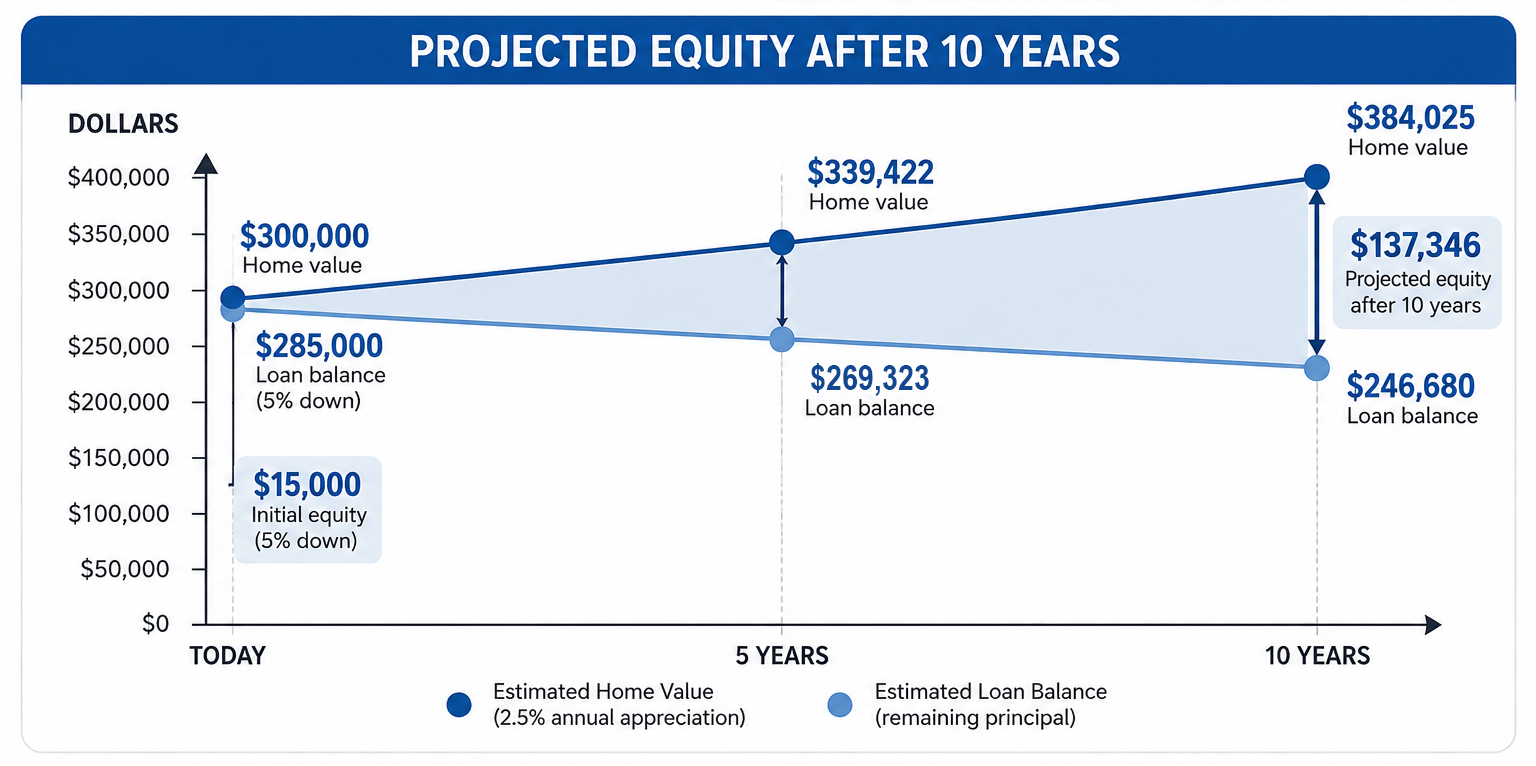
In this example, the homeowner begins with $15,000 in equity from their down payment. After 10 years, that equity could grow to approximately $137,000 through a combination of increasing property value and reducing the mortgage balance.
That’s the potential power of time working alongside homeownership. You don’t have to perfectly predict the housing market to build equity. Sometimes, the most important part is simply giving your investment time to grow.
This hypothetical illustration assumes 2.5% annual home appreciation and scheduled mortgage payments. Actual home values may rise or fall. Figures exclude property taxes, insurance, mortgage insurance, maintenance, selling costs, and other homeownership expenses. Equity is not the same as net profit.
The Cost of Waiting
One of the biggest questions prospective homebuyers face is whether they should purchase now or wait for better market conditions. Will interest rates fall? Will home prices come down? Will more homes become available?
Those are reasonable questions, but there’s another worth considering: What might waiting cost you?
If home prices continue rising, the same property could become more expensive. Rent payments may increase, and every year spent waiting is another year before you start reducing your own mortgage balance and potentially benefiting from appreciation.
Even if mortgage rates eventually decline, lower rates could bring more buyers into the market, potentially increasing competition and pushing prices higher. And while refinancing may be an option in the future, depending on rates and borrower qualifications, the years spent waiting cannot be recovered.
That doesn’t mean everyone should rush into buying a home. Sometimes waiting to improve your credit, reduce debt, or build savings is the smartest financial decision. But waiting solely to perfectly time the market can carry its own costs.
The best time to buy isn’t necessarily when the market is perfect. It’s when homeownership makes financial sense for you.
Building Wealth Isn’t About a Perfect Strategy
Building wealth doesn’t necessarily require an extraordinary income, a complicated investment strategy, or the ability to predict what financial markets will do next. More often, it comes down to making thoughtful decisions, living within your means, investing consistently, and giving those decisions time to work.
Homeownership can be an important part of that strategy. Beyond providing a place to live, it offers the opportunity to gradually build equity in an asset that has historically increased in value. While no investment is without risk, time, consistency, and responsible financial decisions can be remarkably powerful.
If you’re serious about building wealth, don’t focus exclusively on what you buy or when you buy. Think about how long you’re willing and able to stay invested. Because in the end, time isn’t just money; it’s the engine that turns decisions into wealth.
Wondering whether now is the right time to purchase a home? Our team at Homestead Financial Mortgage can help you explore your financing options and determine what makes sense for your financial goals.