If you’ve looked at mortgage rates lately, you may have asked yourself, “Does buying a home still make sense?” And that’s a fair question because rates are higher than they were a few years ago, home prices remain elevated in many areas, and in some cases, renting may cost less each month than buying a comparable home.
But the rent-versus-buy decision is about more than which monthly payment is lower today. It is also about where that money goes, how long you plan to stay, how your housing costs may change over time, and whether you are building an asset along the way.
What Does Today’s Market Look Like?
Mortgage rates are an important part of the equation. As of August 20, 2026, the average rate on a 30-year fixed mortgage was about 6.65%, according to Freddie Mac. While that may feel high compared with the exceptionally low rates available during the COVID-era housing market, those rates were historically unusual. Today’s rates are much closer to longer-term norms.
But the interest rate is only one part of the equation. Home prices matter too, and they can vary significantly from one market to another. In St. Louis, for example, the median home sale price was about $265,000 in June 2026, roughly 37% below the national median. We’ll use that $265,000 price as a benchmark to compare renting and buying, but it’s also important to remember that home prices continue to change over time. Waiting for a lower interest rate could mean shopping at a different price point later, which is another factor to consider when deciding when to buy.
How Does Renting vs Buying Compare?
Rent varies by property type and location, just like home prices. In St. Louis, recent estimates put average rent at around $1,250 per month overall, about $1,385 for a two-bedroom apartment, and roughly $1,466 for a house.
Using a $265,000 home as an example, a 30-year fixed mortgage at 6.875% would have a principal-and-interest payment of approximately $1,653.82 per month with 5% down, or about $1,392.69 per month with 20% down. A homeowner’s total monthly payment would also include property taxes, homeowners insurance, and potentially mortgage insurance or HOA dues. But these numbers can look very different from buyer to buyer. There are other ways that may help reduce the monthly payment, which is why it’s worth looking at your specific options rather than relying on averages.
In our example above, renting may look like the more affordable option, and for some people, it may be. But the monthly payment only tells part of the story. When you rent, your payment provides a place to live for that month. When you own, part of each mortgage payment goes toward reducing what you owe and increasing your ownership in the property.
That is equity, and it is where the rent-versus-buy comparison starts to look different over time.
Homeownership Can Help Build Wealth
This is one of the biggest differences between renting and buying.
Homeownership comes with real expenses to consider, including interest, taxes, insurance, repairs, and maintenance. But every mortgage payment also includes principal, which gradually reduces what you owe.
If the home increases in value over time, your equity can grow in two ways: through paying down the mortgage and through potential appreciation, as shown in the graphic below.
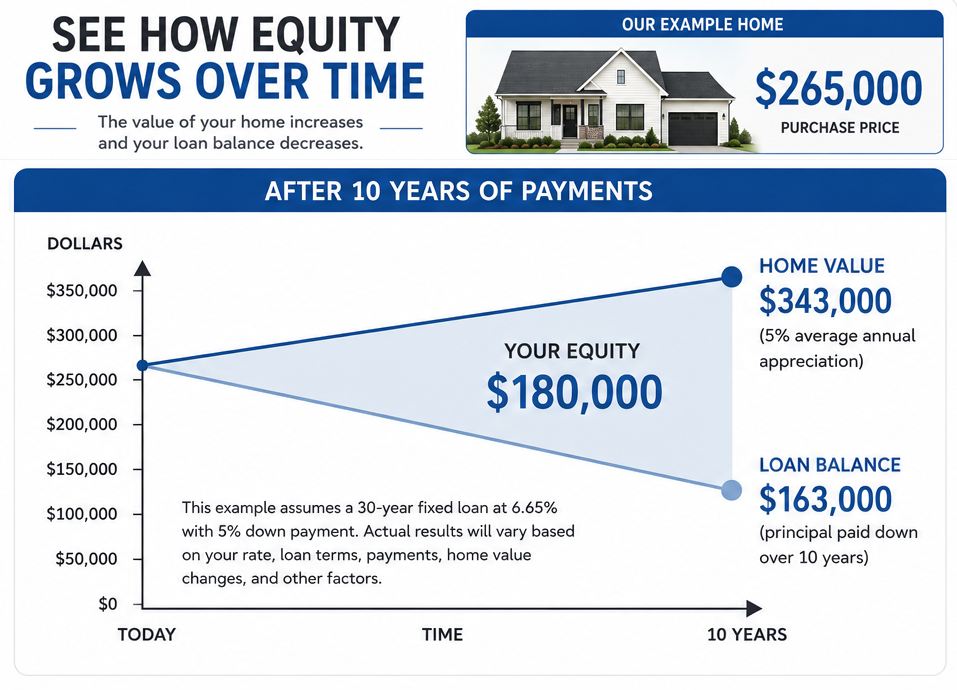
Appreciation is never guaranteed, but homeownership has historically played an important role in household wealth. Federal Reserve data shows a significant difference in median net worth between homeowners and renters, with housing equity accounting for a major share of homeowners’ wealth.
That is why a home can be more than a monthly expense. Over time, it can become a meaningful financial asset.
A Fixed-Rate Mortgage Can Offer More Stability
Rent can increase when a lease renews. A fixed-rate mortgage works differently.
With a fixed-rate loan, the principal-and-interest portion of your payment stays the same for the life of the mortgage. Property taxes, insurance, HOA dues, and other costs can still change, but the base mortgage payment does not increase simply because housing costs around you have gone up.
That stability can become more valuable the longer you own your home.
What If Rates Go Down Later?
Many buyers hesitate because they worry about purchasing now only to see rates fall later.
That is understandable, but waiting comes with its own uncertainty. Rates could fall, stay about the same, or rise. Home prices could also continue increasing while you wait.
If rates do fall meaningfully in the future, refinancing may be an option depending on your situation. There is no guarantee that refinancing will make sense, so a home purchase should still be affordable based on today’s numbers.
Trying to perfectly time the market is difficult. A better approach is to determine whether buying makes sense for your finances and your plans right now.
Buying Also Gives You More Control
There are personal benefits to owning that do not always show up in a spreadsheet.
When you own your home, you have more freedom to make it yours. You can paint, renovate, update flooring, build a patio, or make other changes without asking a landlord for permission.
Homeownership can also provide more stability. You are not wondering whether your landlord will raise the rent, sell the property, or choose not to renew your lease.
For many people, that sense of control is an important part of the decision.
When Renting May Make More Sense
Buying is not automatically the better choice for everyone.
Renting may make more sense if you expect to move within a few years, your income is likely to change, buying would leave you without enough emergency savings, or you are still working on your credit or overall financial picture. It may also be a better fit if you are not ready for the maintenance and responsibilities that come with owning a home.
The strongest case for buying is usually when you are financially prepared and expect to stay long enough for the benefits of ownership to build over time.
So, Is It Better to Buy or Rent Right Now?
There is no one-size-fits-all answer.
If you are only comparing this month’s payment, renting may come out ahead. But if you are looking at the next five, ten, or twenty years, the picture can look very different.
Buying gives you the opportunity to build equity, benefit from potential appreciation, create more stability in your principal-and-interest payment, and turn part of your monthly housing cost into ownership of an asset.
So instead of asking, “Are rates too high to buy?” a better question may be, “Am I financially ready to buy, and does buying make sense for my specific situation?”
Don’t Guess. Run Your Numbers.
At Homestead Financial Mortgage, we can help you look at the numbers based on your unique situation. That includes estimated monthly payments, upfront costs, and available loan options.
Market averages and charts can be helpful starting points, but they don’t tell the full story. Your personal finances are what ultimately determine what homeownership could look like for you.
Speak with one of our loan advisors to decide whether buying now, preparing to buy later, or continuing to rent makes the most sense for you.
*Based on a 780 credit score. 5% down payment. 360 monthly payments of 6.875% rate (APR 6.947%). 20% down payment. 360 monthly payments of 6.875% rate (APR 6.947%). Fixed rate mortgage. Subject to credit approval. The information provided by Homestead Financial Mortgage is for educational purposes only and is not a commitment to lend. These figures are an estimation and may not reflect the exact terms of your loan. Products and interest rates are subject to change at any time due to fluctuating market conditions. Actual rates may vary based on factors such as credit score, down payment, loan type, and documentation provided. Homestead Financial Mortgage is an Equal Housing Lender / For licensing information, go to: www.nmlsconsumeraccess.org